

Latest Information
-
A message to students
October 18, 2023 Dear Students, I am writing to address misinformation that has been circulating concerning academic programs. I want you to hear it from me directly. Let’s be abundantly clear: there is no University list of academic programs identified for modification nor discontinuation. Social media posts and other communications indicating such are false. Current…
-
Campus Email on New Data for Rubric Postings
Dear Colleagues, We initially planned to post rubrics populated with data for each metric for each rubric category on September 25th. Based on feedback from training sessions and the desire to have 2023 fiscal data as part of the rubrics, our team needs two weeks to add 2023 financial data and address data questions that…
-
Update from the Provost on Portfolio Review
Dear colleagues, The Portfolio Review rubrics have been finalized and are posted on the innovation/reinvention site. These revisions are the result of three listening sessions hosted by the Portfolio Review Task Force and the comments received via the online feedback form, where approximately 150 university stakeholders shared feedback about the rubric and the portfolio review…
-
rpk Project Update – May 4
University North Carolina GreensboroAcademic Data DashboardsProject UpdateMay 4, 2023 Since the last project update on April 21, 2023, rpk GROUP (rpk) has continued to engage multiple stakeholder groups with project updates. The Data Team continued to meet regularly and has reviewed the list of UNCG’s academic programs that will be in the academic data dashboards.…
-
APRTF Suggestions & Recommendations Request
May 3, 2023 Dear Faculty and Staff, I am reaching out on behalf of the Academic Portfolio Review Task Force (PRTF) to request suggestions and recommendations regarding the portfolio review rubric that we will be developing throughout the summer. The PRTF recently held two listening sessions that were open to all faculty and staff on…
-
Project Update – April 21, 2023
University North Carolina GreensboroAcademic Data DashboardsProject UpdateApril 21, 2023 Since the last project update on April 6, 2023, rpk GROUP (rpk) has continued to engage multiple stakeholder groups with project updates. The Data Team has continued to meet regularly and has confirmed that the dashboard will initially include academic years 2019-2020, 2020-2021, and 2021-2022. The…
-
Invitation to 5/2 Data Dashboard Town Hall and updates from the Provost
Dear Faculty, Before the semester comes to a close, I wanted to give you an update and reminder regarding several items that I hope you will find to be of interest. Last week you received an email describing the final Academic Portfolio Review Process and timeline, which has also been posted here. I’m pleased to…
Graduate Student Forum With Chancellor Gilliam
Dear Graduate Students,
On Tuesday, Nov. 28th, please join me, the Graduate Student Assocation, and Chancellor Gilliam for a forum regarding the University’s academic portfolio review. The GSA requested this opportunity to discuss the academic portfolio review process with the Chancellor and I hope you can join us. The in-person forum will be held in the School of Education, Room 114 from 2:00 p.m. to 3:30 p.m. The forum will also be live streamed for those unable to be present in-person. Students should check their email for the official link to the livestream.
Academic Portfolio Review Timeline – Nov 20, 2023
UNC Greensboro is undergoing a long-standing best practice in higher education known as academic portfolio review. Its objective is to ensure the University has the right mix of academic offerings to fulfill student needs, remain competitive, and allocate sufficient support for programs.
The thorough timeline here chronicles the current portfolio review from its beginnings in late 2022 through its planned conclusion in 2024. Please note that some dates in the timeline are subject to change; they reflect the best projections available.
A Message from the Chancellor
On Oct. 24, 2023, Chancellor Gilliam shared a message with faculty and staff regarding the University’s finances. To read the message, click here. Below you will see the supporting slides of accurate University budget information refuting the primary conclusions in the AAUP report. University financial operations are complex, but our challenge boils down to this: we are bringing in fewer of the kinds of dollars we can use for academic programs.
1 of 7
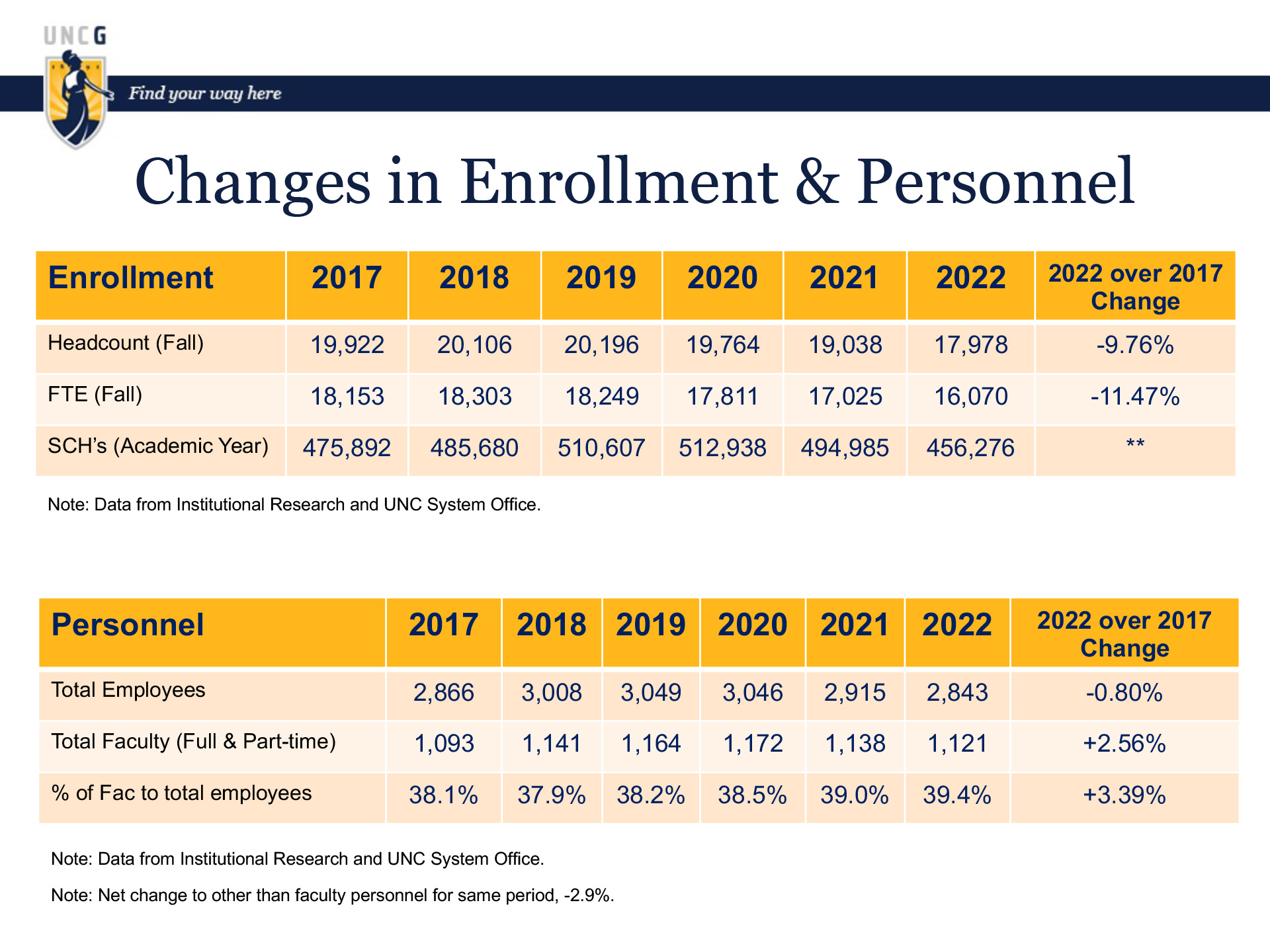
Over 85% of the University’s budget is dependent on enrollment. This slide includes headcount and student credit hours (which state appropriations are based on). As you can see, as measured by headcount, FTE, and SCH, overall enrollment is down significantly. As the second table shows, the University has increased faculty personnel during this enrollment decline while other units, including administrative, have decreased personnel.
2 of 7
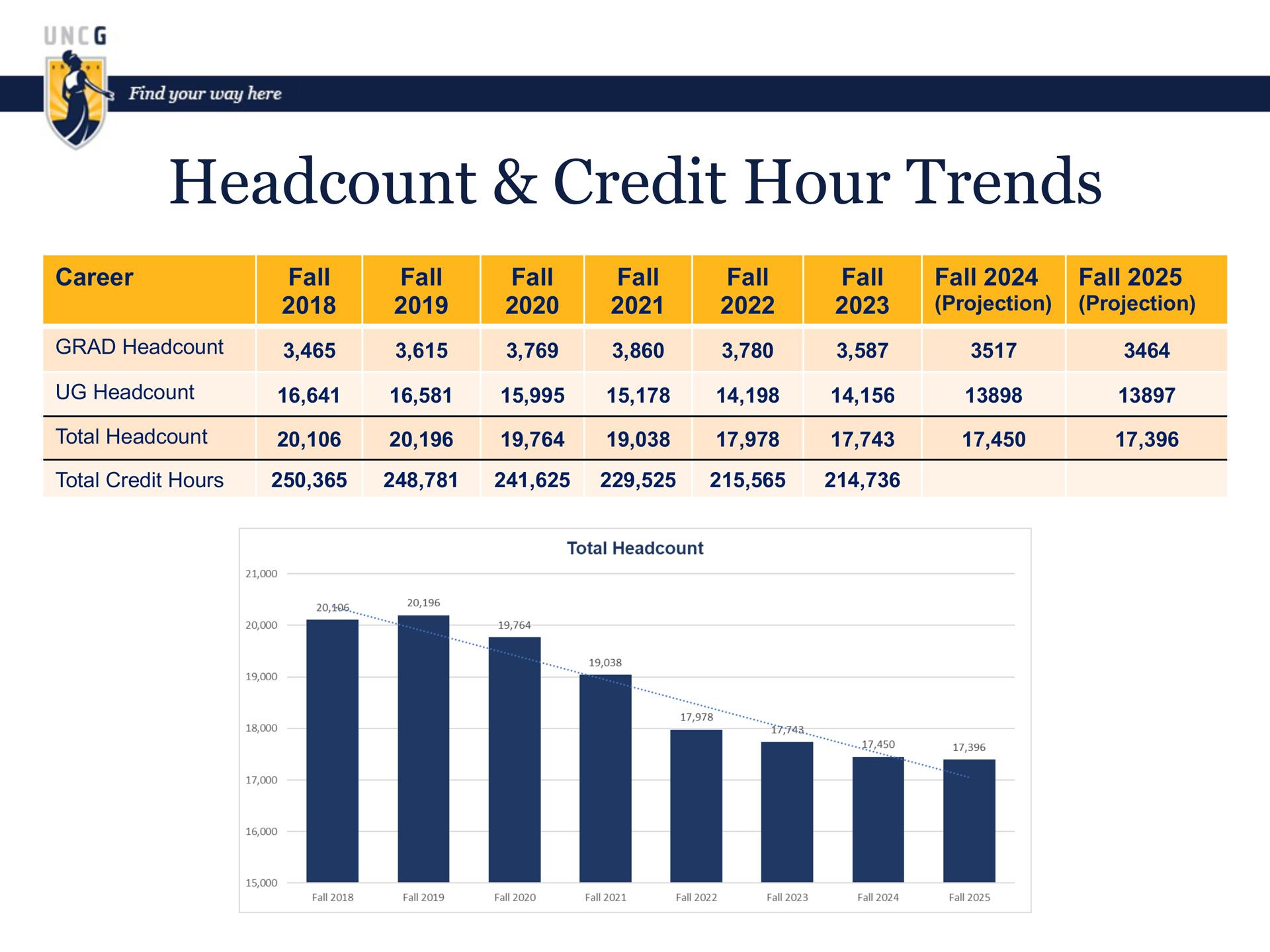
This data shows graduate and undergraduate trends since 2018. Note that we are projecting declines in graduate enrollment and accounting for continuing cohort drag from smaller incoming classes in 2021 and 2022. We expect small gains in undergraduate enrollment in the coming years, but not enough to make up for the cohort drag and graduate enrollment declines. In addition, all demographic projections are that there will be fewer available undergraduates both in the U.S. and North Carolina after 2025. An enrollment rebound is not likely, and we must adjust.
3 of 7
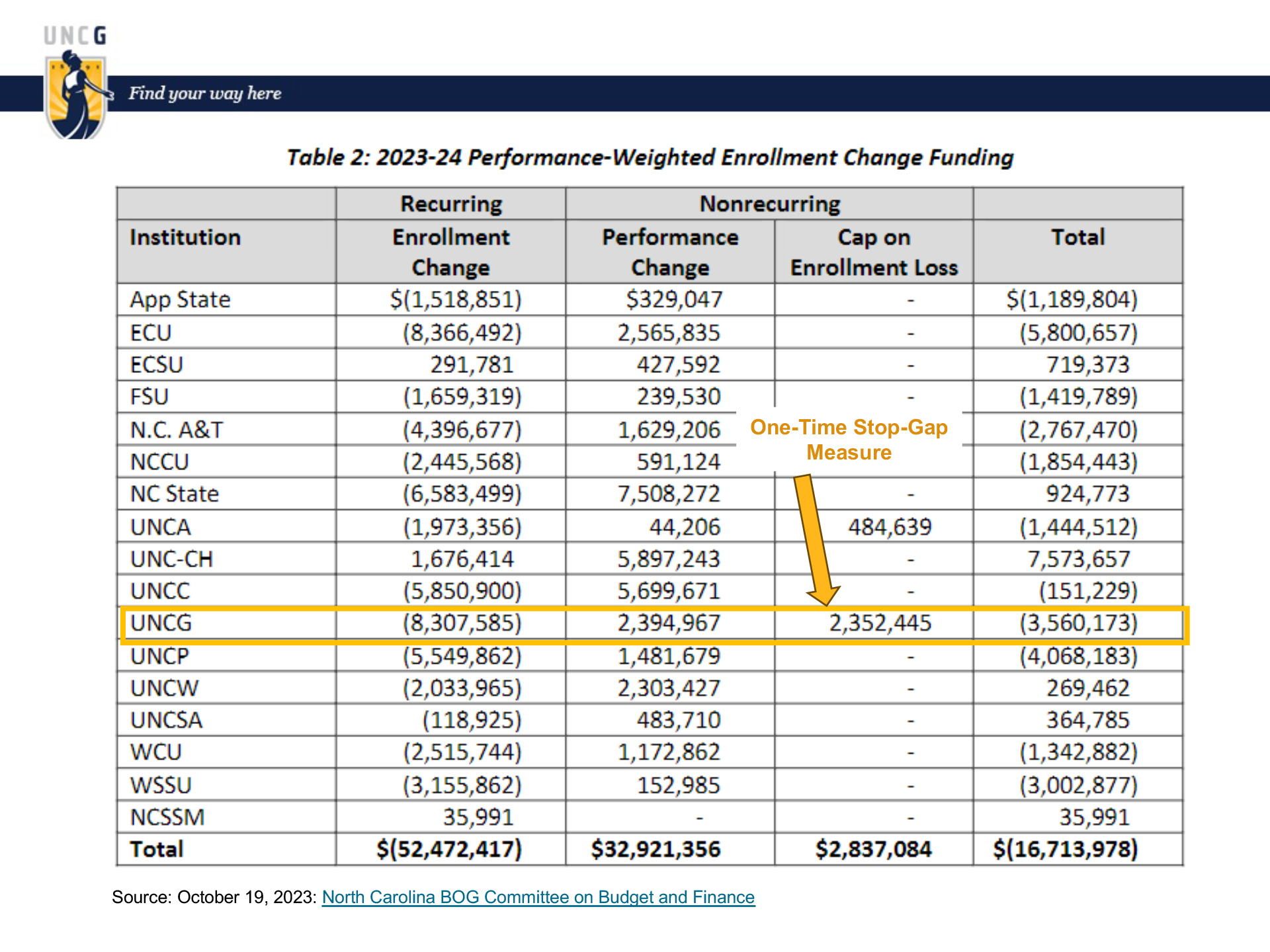
The AAUP report claims that UNCG does better under the new funding model. This is false. This slide from the UNC System Office shows how each campus fares under the new model. Note, UNCG is down $8m under the new model compared to last year (and gains $2.3m in performance weighting). Also of note, in December 2022, the Chancellor went before the Board of Governors and asked for a special “stop gap” measure of $2.3m to help UNCG adjust to the change in the new funding formula. It was granted but was told not to come before the Board again with another such request. The Chancellor wouldn’t have requested, nor the Board of Governors granted this special accommodation, if we had the unlimited resources the AAUP report claims the University has.
4 of 7
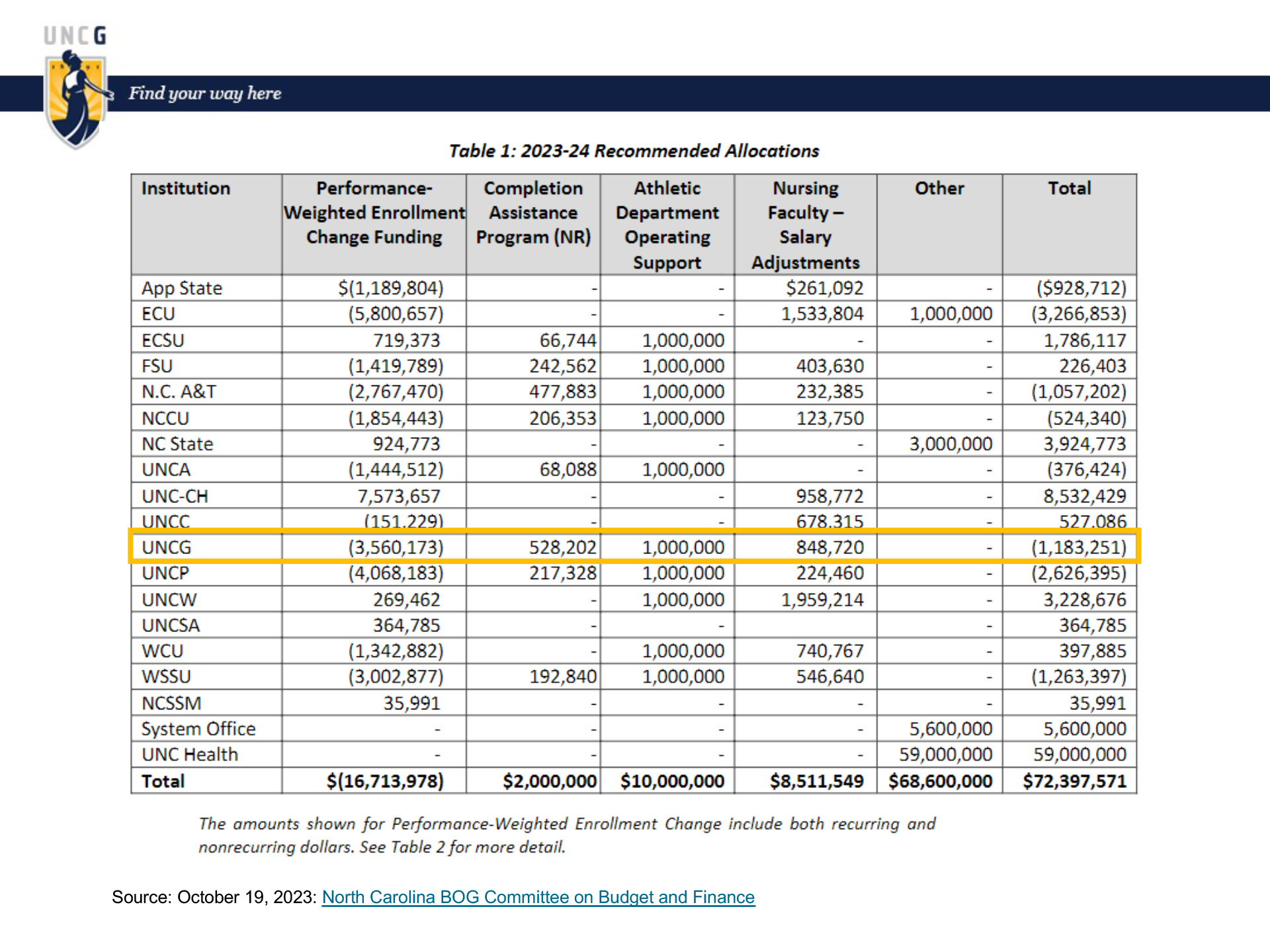
This slide shows our additional non-capital appropriations from the Legislature, but even with these additional appropriations we are still to the negative.
5 of 7
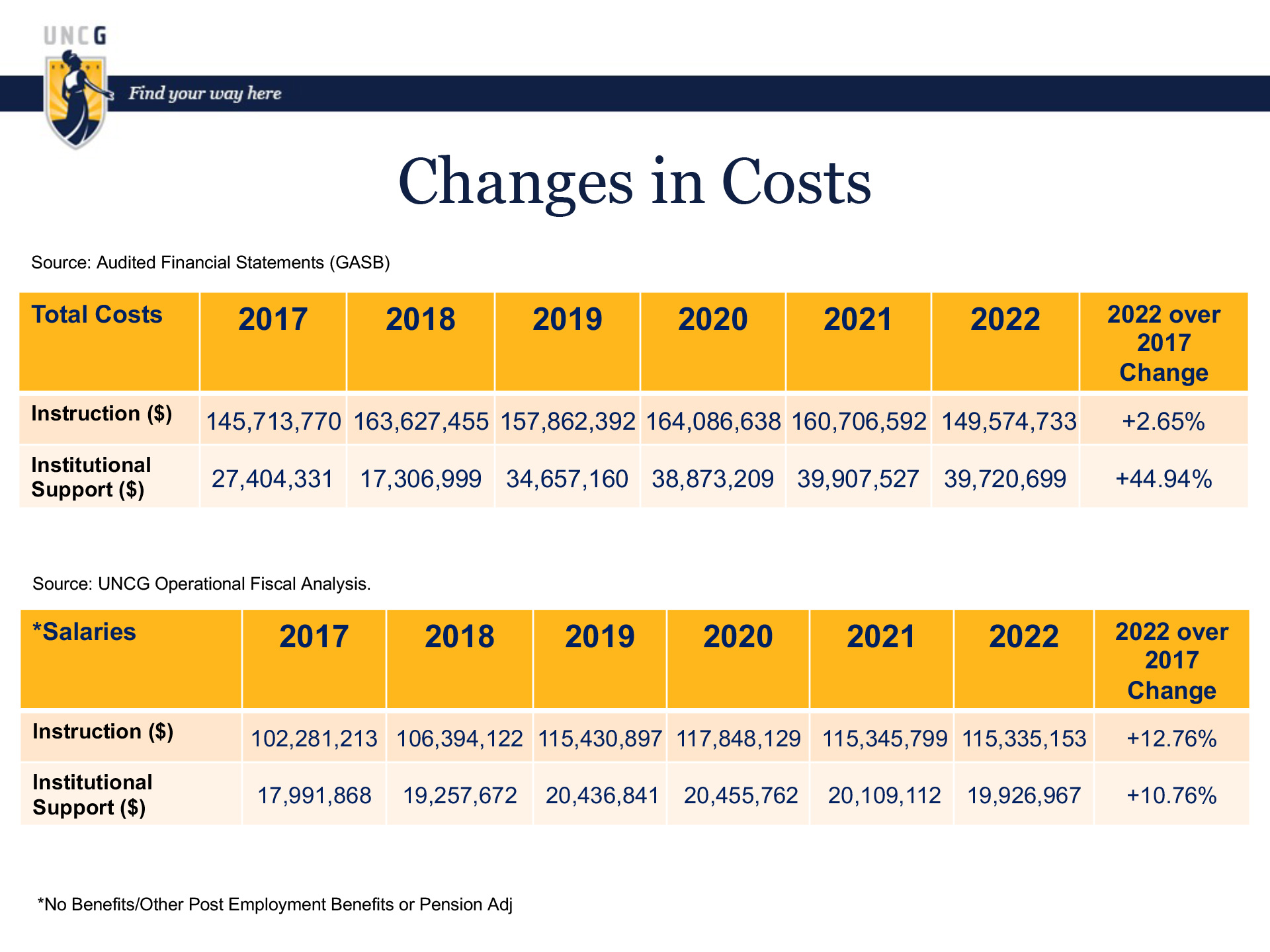
The top table is AAUP/Bunsis information. Financial statements are aggregate, presenting general financial information in a manner that can be read by multiple audiences. For instance, this budget category includes significant post-employment (retirement) benefits (labeled OPEB in the financial statement). This failure to disaggregate the data is the source of Bunsis’s egregiously mistaken claim that the university is disproportionately spending on administration over instruction. The bottom table disaggregates the instructional and institutional costs, reconciled to the audited financial statement, excluding benefits, HEERF and nonwage items, which translates to what was spent on salaries. As you can see, what we spent on instructional salaries (in the aggregate) outpaced slightly institutional support salaries.
6 of 7
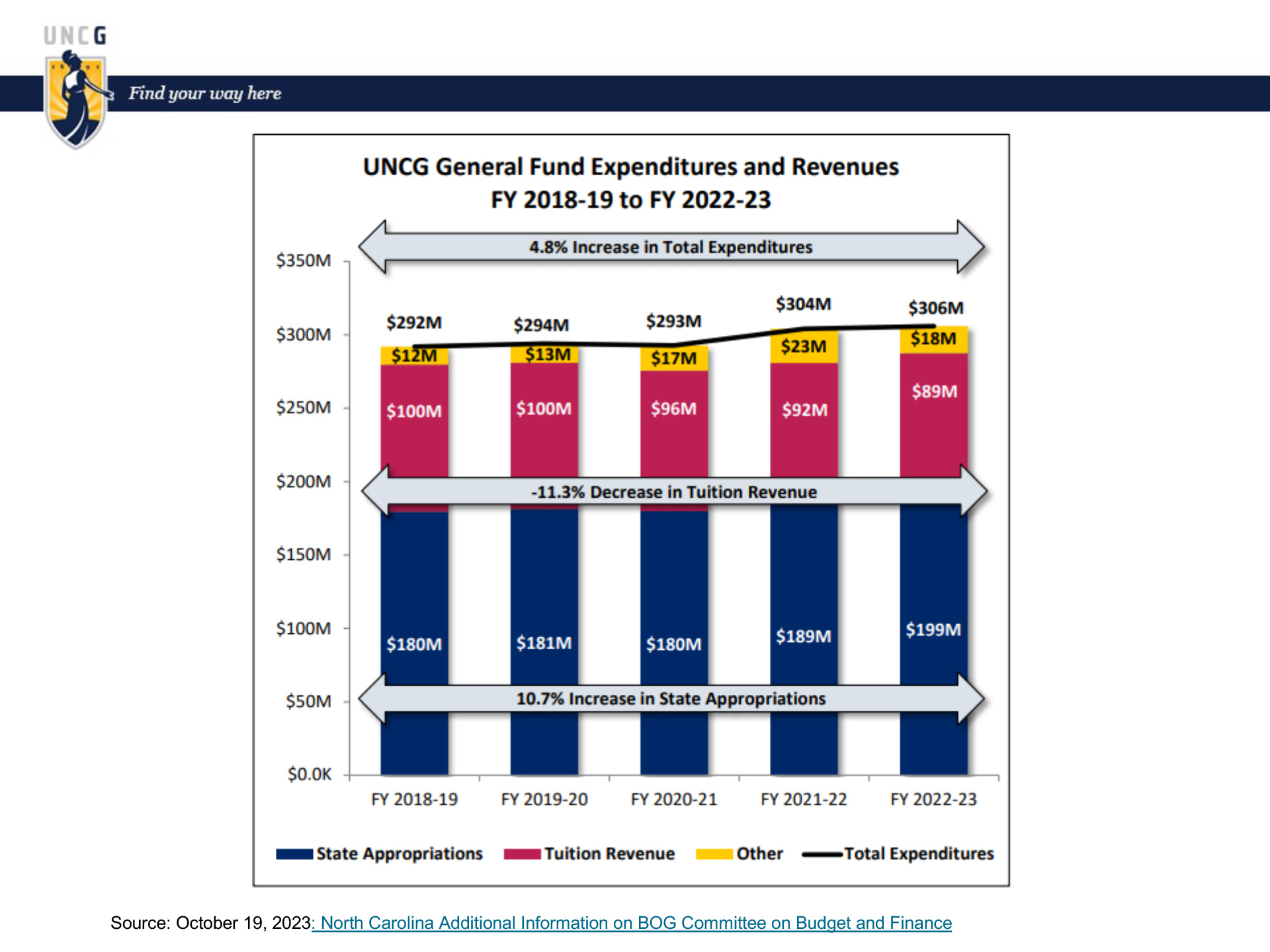
These data show the increase in total expenditure and decrease in tuition revenue. Note that the state appropriations increases are largely due to legislative salary increases for employees (essentially a pass through in our budget) and specific projects (e.g., Jackson Library, Chiller Plant, Steam Plant, other repairs and renovations).
7 of 7
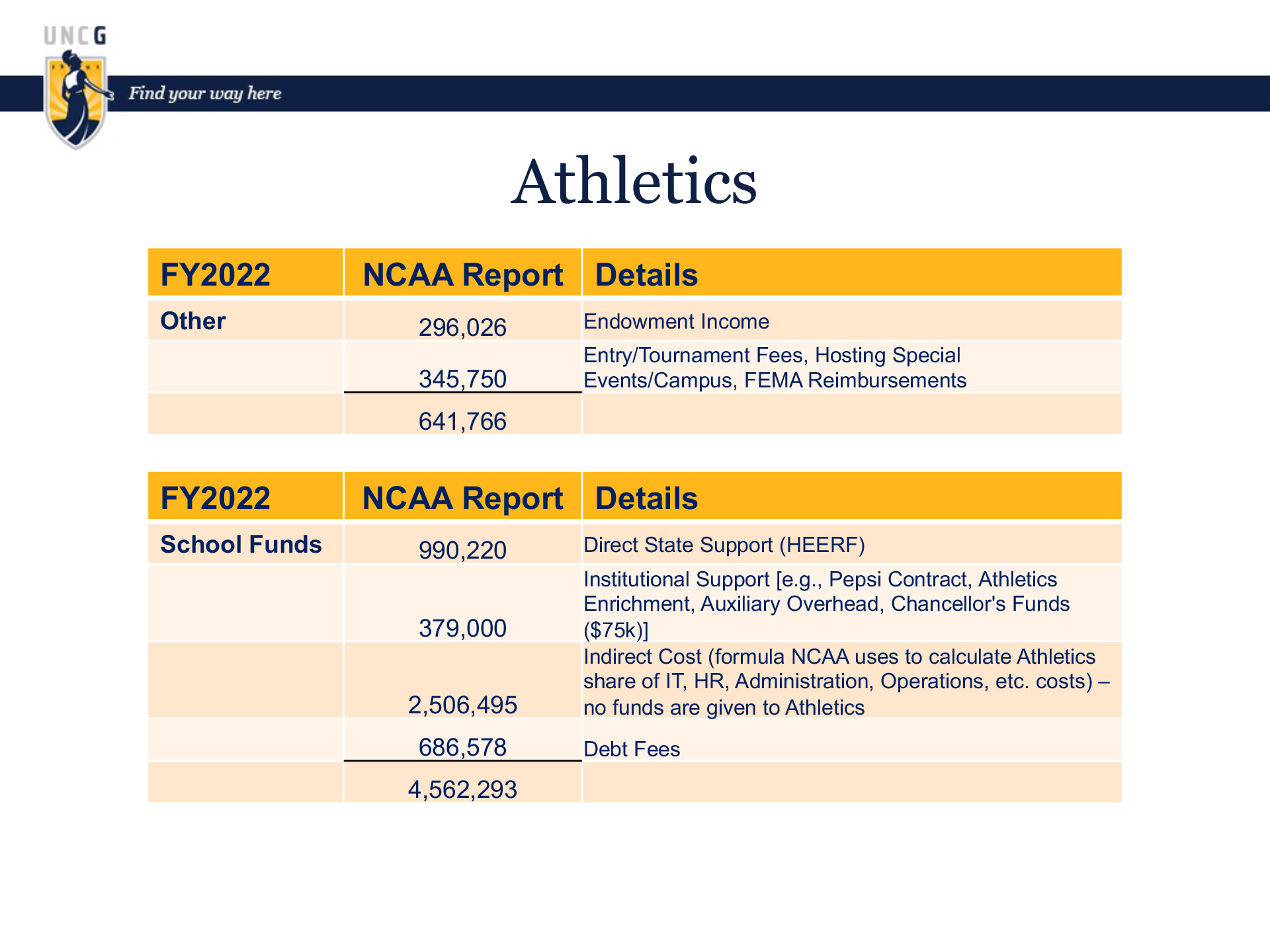
The AAUP report also recommends that we cut athletics spending. Bunsis claims that the University redirects spending from academics to athletics to the tune of $4.5 million dollars. Athletics is funded primarily by the student athletics fee (approximately 85% of their budget), which cannot be used for other purposes. Hypothetically even if we eliminated this athletic student fee (or athletics department for that matter), we would not be able to repurpose the fee. In addition, athletics is also funded by philanthropy, NCAA contributions, and small contributions from ticket revenue and concessions. There was a one-time allocation of $990K in funding from federal HEERF (Higher Education Emergency Relief Funds) dollars, $379,000 from a Pepsi contract, and a small contribution from the Chancellor’s fund ($75k). The NCAA requires us to calculate indirect costs to support Athletics, much like we do when determining our overhead rate for grants and contracts. This includes in-kind salaries from human resources, IT, finance and administration, and other areas. These are not fund allocations distributed to Athletics (as the AAUP report would have you believe), but instead, a calculation of how much time is devoted from various areas in the institution to support Athletics.